USA vs Australia: Match Preview, Predictions and Betting Tips
Published on Wednesday, 17 June 2026 by Steve


USA vs Australia
FIFA World Cup 2026 Prediction & Betting Tips
Match Overview

John and Harry Souttar's World Cup Journey Draws Global Attention – FutbolPulse
The United States Men's National Team faces a pivotal second group stage match against Australia at Seattle Stadium on June 19, 2026, in what promises to be one of the most consequential fixtures of the FIFA World Cup group stage. As co-hosts of the expanded 48-team tournament, the USMNT carries the weight of a nation's expectations on home soil, with manager Mauricio Pochettino tasked with navigating a squad brimming with talent through the unforgiving pressure of a World Cup campaign. This encounter against the Socceroos represents far more than a routine group stage fixture—it is a clash between two teams with vastly different footballing philosophies, converging on the biggest stage in world football. The Americans enter this match buoyed by their tournament opener and the electric atmosphere generated by over 69,000 passionate supporters at one of North America's most iconic sporting venues, while Australia arrives with their trademark resilience and tactical discipline that has become synonymous with the Socceroos' identity under Tony Popovic.
The significance of this fixture extends beyond the immediate three points at stake. For the United States, a victory would all but secure progression to the knockout phase with a game to spare, allowing Pochettino the luxury of rotating his squad for the final group match against Türkiye. For Australia, fresh off their opening match against Paraguay, this represents their most daunting challenge in Group D—a test of whether their compact defensive structure and rapid transition play can withstand the sustained pressure of a host nation playing before a raucous home crowd. The tactical battle between Pochettino's fluid, possession-based 3-2-5 system and Popovic's disciplined 3-4-2-1 counter-attacking framework will captivate tactical analysts and casual viewers alike. Both managers have meticulously prepared their squads throughout the 2025-2026 season, and the decisions made on this Friday evening in Seattle will reverberate throughout the remainder of the tournament for both nations.
Historical context adds another layer of intrigue to this encounter. The two nations met most recently in October 2025, when the United States secured a dramatic 2-1 comeback victory at Dick's Sporting Goods Park in Commerce City, Colorado. On that occasion, Haji Wright's brace overturned an early Jordan Bos goal for Australia, though the match was overshadowed by an injury to Christian Pulisic that raised concerns about the USMNT captain's fitness heading into the World Cup. That friendly result ended Australia's impressive 12-game unbeaten streak and provided Pochettino with valuable insights into how his system performs against the Socceroos' defensive organization. However, World Cup matches bear little resemblance to friendly encounters—the stakes, intensity, and tactical approach shift dramatically when tournament survival hangs in the balance. With both squads finalized after months of preparation, and with the global spotlight firmly fixed on Seattle, this match represents the definitive chapter in what is rapidly becoming a compelling trans-Pacific footballing rivalry. For bettors seeking full-time prediction analysis, the dynamics of this fixture offer fascinating possibilities.
Tactical Preview
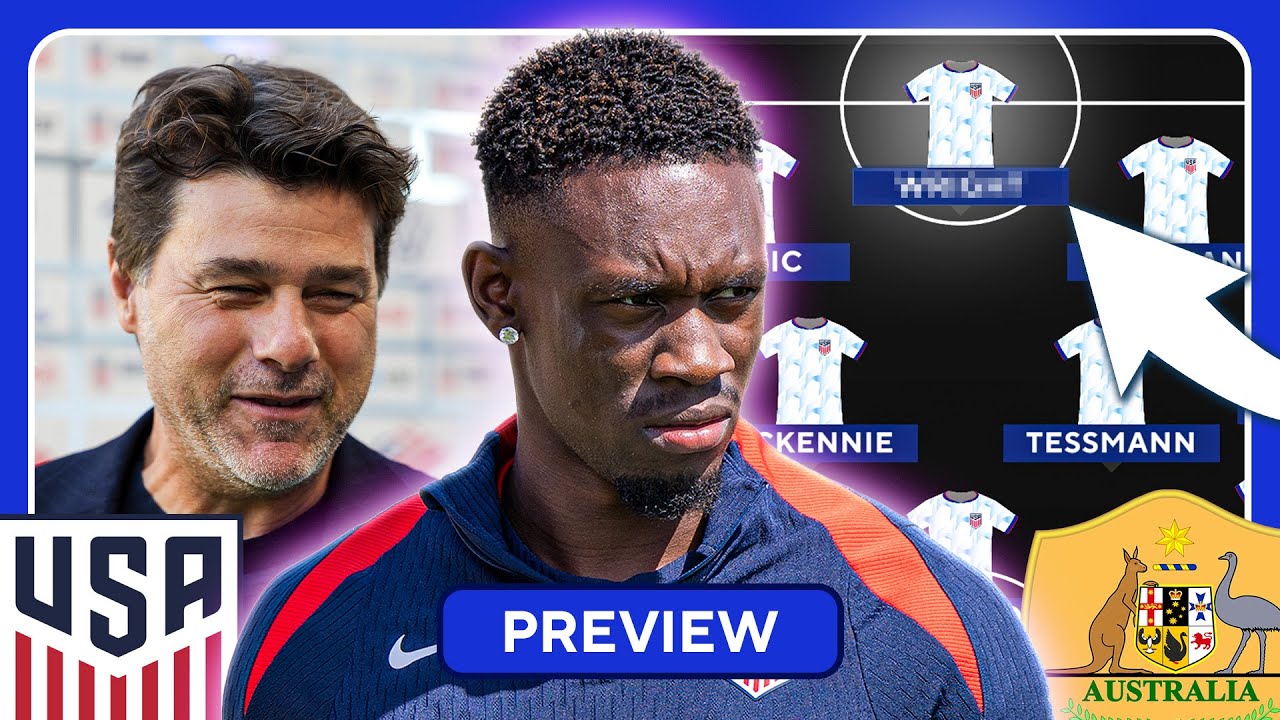
Should Folarin Balogun START for the USMNT vs. Australia? | USA vs. AUS Match Preview | CIWYW
Formation & Key Matchups
USA 3-2-5 (in possession) / 4-4-2 (out of possession)
Mauricio Pochettino has revolutionized the USMNT's tactical approach since his appointment in September 2024, building upon the positional play foundations laid by Gregg Berhalter while injecting a distinctly South American fluidity and verticality. In controlled possession, the United States morphs into an aggressive 3-2-5 shape designed to create numerical overloads across the forward line and pin opposition defenses deep within their own third. The system relies heavily on Antonee Robinson's explosive overlapping runs from left wing-back, complementing Christian Pulisic's tendency to drift inside from the left flank into dangerous half-spaces. On the right, Timothy Weah maintains width to stretch defensive structures, while the double pivot of Tyler Adams and Weston McKennie provides both defensive shielding and progressive passing. The deliberate positional chaos created by continuous rotations unbalances defensive organizations, forcing opponents into tracking decisions that can dismantle their shape. Against Australia's compact 3-4-2-1, the key challenge for the Americans will be finding space between the Socceroos' disciplined defensive lines, particularly when Australia drops into a low block after gaining an early lead. Pochettino's system demands extreme physical intensity combined with complex structural rotations—a requirement that has become deeply ingrained through months of intensive training. The 38-year-old Tim Ream serves as the primary ball-playing center-back, initiating buildup with his elite passing range, while Chris Richards provides defensive aggression and aerial dominance when fit. However, Richards' ankle ligament damage sustained during Crystal Palace's final Premier League match remains a concern, with his availability potentially determining whether the USMNT can maintain defensive solidity against Australia's physical forward line. For those interested in the evolution of football tactics, Pochettino's hybrid system represents a fascinating case study in modern tactical innovation.
Australia 3-4-2-1
Tony Popovic has instilled a meticulously organized defensive structure since taking the Socceroos reins in September 2024, transforming Australia into one of the most disciplined sides in Asian football. The 3-4-2-1 formation prioritizes defensive solidity above all else, with three center-backs—typically Harry Souttar, Cameron Burgess, and Alessandro Circati—forming an impenetrable defensive block that conceded just 0.44 goals per 90 minutes during World Cup qualification. The wing-backs, particularly Jordan Bos on the left, provide the primary attacking width, pushing high into the opposition half while maintaining defensive responsibilities. In central midfield, Jackson Irvine and Aiden O'Neill form a combative double pivot tasked with breaking up opposition attacks and quickly distributing the ball to launch offensive transitions. The two attacking midfielders, often featuring the dynamic Nestory Irankunda and experienced Ajdin Hrustic, operate in the half-spaces between opposition full-backs and center-backs, seeking to exploit gaps during rapid counter-attacks. The system demands exceptional physical fitness and unwavering concentration—qualities that Popovic, a former commanding center-back with 58 international caps, demands from every squad member. Against the United States, Australia's tactical approach will likely involve ceding possession and absorbing pressure before striking on the break through Irankunda's blistering pace or Mohamed Touré's intelligent movement. The Socceroos' success in this fixture hinges on their ability to maintain defensive discipline for 90 minutes while converting limited scoring opportunities—a formula that has served them well throughout qualification but will be severely tested by the quality and depth of Pochettino's attacking options. Fans exploring over-under prediction markets should note that Australia's defensive record suggests a potentially low-scoring encounter.
Critical Vulnerability
The decisive tactical battleground in this fixture lies in how Australia's compact defensive block handles the United States' intricate positional rotations, particularly on the left flank where Pulisic and Robinson combine. If Pulisic is fully fit and firing, his ability to draw multiple defenders before releasing Robinson into space behind Australia's wing-back could unlock the Socceroos' defensive structure. Conversely, if Australia can successfully isolate Pulisic and prevent Robinson's overlapping runs, they force the Americans into less dangerous central areas where Irvine and O'Neill excel at winning second balls and launching counters. The set-piece battle also warrants attention—Harry Souttar's aerial dominance (standing at 6'6") presents a significant threat against a USMNT defense that has occasionally struggled with organized dead-ball situations. Additionally, the high defensive line that Pochettino employs to compress space and facilitate pressing leaves vulnerabilities in behind that a pacey forward like Irankunda could exploit, particularly if the American full-backs are caught high up the pitch. The goalkeeping situation adds another layer of uncertainty; while Matt Turner provides experience, his recent club form has been inconsistent, and Pochettino's system demands a sweeper-keeper willing to command the space behind a high line. Australia's Mathew Ryan, by contrast, arrives in exceptional form after helping Levante avoid relegation in LaLiga, providing the Socceroos with a reliable last line of defense and confident distributor from the back. These vulnerabilities and strengths create a fascinating tactical chess match that could be decided by individual brilliance or a single moment of defensive lapse. Those analyzing advanced live betting metrics should monitor these tactical adjustments as the match unfolds.
Team News & Squad Status
USA 🔥
- Christian Pulisic declared fit after hip bursitis scare—expected to start and captain the side
- Chris Richards (ankle ligaments) underwent intensive recovery program; match fitness being assessed daily
- Johnny Cardoso ruled out of tournament due to injury requiring surgery—significant midfield blow
- Folarin Balogun enters match in scintillating form after 9-match scoring streak for AS Monaco
- Haji Wright rewarded with starting role after brace against Australia in October 2025 friendly
- Antonee Robinson fully recovered from minor knock that kept him out of October friendly
- Tim Ream (38) provides veteran leadership and ball-playing ability from center-back
- Weston McKennie and Tyler Adams form established double pivot with excellent chemistry
- Diego Luna emerged as surprise package during qualification; pushing for starting role
- Matt Turner retains goalkeeper position despite competition from Matt Freese
- Sergiño Dest offers creativity and width from right wing-back position
- Malik Tillman provides tactical flexibility as false nine or attacking midfielder
- Gio Reyna included in squad despite limited minutes; impact substitute potential
- Brenden Aaronson offers high-energy pressing from wide positions
- Ricardo Pepi provides clinical finishing option from bench after 15-goal Eredivisie season
Australia 🇦🇺
- Mathew Ryan confirmed as captain and starting goalkeeper after outstanding LaLiga season
- Jordan Bos fully fit and expected to start at left wing-back after scoring in October friendly
- Harry Souttar anchors defense with commanding aerial presence and leadership
- Cameron Burgess partners Souttar after consistent Championship season with Swansea
- Alessandro Circati completes back three; composed ball-playing defender for Parma
- Jackson Irvine and Aiden O'Neill form combative central midfield partnership
- Nestory Irankunda (20) declared fit and ready to start as primary attacking threat
- Mohamed Touré preferred striker option after energetic display in pre-tournament friendlies
- Ajdin Hrustic provides creativity and set-piece expertise from attacking midfield
- Connor Metcalfe offers box-to-box energy and late-arriving goal threat
- Martin Boyle provides experienced wide option; impact substitute role likely
- Aziz Behich offers reliable backup at left wing-back if Bos requires rest
- Miloš Degenek provides versatile defensive cover across back three
- Mathew Leckie included in squad despite limited minutes; veteran presence valuable
- Paul Izzo and Patrick Beach provide goalkeeper depth behind Ryan
Predicted Lineups

USMNT, Fulham star Antonee Robinson reveals tendinopathy behind decision to withdraw from CONCACAF Nations League squad | Goal.com Australia
| USA 3-2-5 | Australia 3-4-2-1 |
|---|---|
| Matt Turner (GK) | Mathew Ryan (GK, C) |
| Tim Ream (LCB) | Harry Souttar (CB) |
| Chris Richards (CB) | Cameron Burgess (CB) |
| Miles Robinson (RCB) | Alessandro Circati (CB) |
| Antonee Robinson (LWB) | Jordan Bos (LWB) |
| Tyler Adams (CDM) | Jackson Irvine (CDM) |
| Weston McKennie (CDM) | Aiden O'Neill (CDM) |
| Sergiño Dest (RWB) | Jason Geria (RWB) |
| Christian Pulisic (LW, C) | Nestory Irankunda (CAM) |
| Malik Tillman (CAM) | Ajdin Hrustic (CAM) |
| Timothy Weah (RW) | Mohamed Touré (ST) |
| Folarin Balogun (ST) | — |
Head-to-Head Record

Jackson Irvine - Every Goal for the CommBank Socceroos ⚽💚💛 - YouTube
The United States and Australia share a brief but intriguing competitive history, having faced each other on just four previous occasions across all competitions. Their first meeting came in 1992, when the Americans secured a narrow 1-0 victory in a friendly match that offered little indication of the footballing trajectories both nations would follow over the subsequent three decades. The most significant encounter prior to this World Cup fixture occurred in 2010, when the two teams played out a 3-3 draw in a warm-up friendly ahead of the South Africa World Cup—a match memorable for its attacking intent and defensive fragility from both sides. The most recent meeting, on October 14, 2025, at Dick's Sporting Goods Park in Commerce City, Colorado, provided the most relevant tactical insights for this fixture. On that occasion, the United States fell behind to a Jordan Bos goal in the 19th minute after a defensive error from a throw-in, before Haji Wright's brace in the 33rd and 51st minutes—both assisted by Cristian Roldan—secured a 2-1 comeback victory. That result ended Australia's 12-game unbeaten streak and demonstrated both the resilience of Pochettino's squad and the vulnerabilities in Australia's defensive structure when subjected to sustained pressure. The match was not without controversy, as Christian Pulisic was forced off in the 31st minute with what appeared to be a hamstring injury, sparking fears about his availability for the World Cup that have since been allayed. For those researching football betting strategies, understanding head-to-head historical context provides valuable insights into potential match outcomes.
The historical record, while limited in sample size, reveals several patterns that could influence this World Cup encounter. The United States has demonstrated a capacity to overcome early setbacks against Australia, as evidenced by their comeback victory in October 2025. Australia's solitary victory in this fixture came in 1992, meaning they have never defeated the Americans in the modern era of international football. The 2010 draw showcased both teams' attacking capabilities, though the defensive improvements implemented by both Pochettino and Popovic suggest that a high-scoring encounter is less likely in 2026. What the head-to-head record cannot fully capture is the dramatic evolution of both squads since their last meeting. The United States has added significant quality through the emergence of Alex Freeman, the continued development of Diego Luna, and the integration of European-based talents like Balogun and Pepi. Australia, meanwhile, has benefited from Nestory Irankunda's rapid progression at Watford and the defensive stability provided by Popovic's systematic approach. The 2025 friendly offered a snapshot of these developments, but the tactical adjustments both managers have implemented since then, combined with the fundamentally different pressures of World Cup football, render historical comparisons merely suggestive rather than predictive. What remains consistent is the competitive intensity both nations bring to the pitch—a shared characteristic that guarantees an engrossing contest regardless of historical precedent. Bettors seeking double chance prediction options should consider the competitive balance these historical meetings suggest.
Key Players Comparison
Christian Pulisic 🇺🇸
The USMNT captain and undisputed talisman, Pulisic enters this World Cup as the most accomplished American player of his generation. With a UEFA Champions League winners' medal and extensive experience in Europe's top leagues, Pulisic possesses the rare ability to change matches through individual brilliance. His tendency to drift from the left wing into central half-spaces creates overloads that unbalance defensive structures, while his close control and acceleration make him a nightmare for opposing full-backs. After a hip bursitis scare in early 2026, Pulisic has declared himself fully fit and determined to lead his country deep into the tournament. His leadership, both vocal and through example, will be crucial in maintaining American composure against Australia's disciplined defensive block. The October 2025 friendly demonstrated Australia's vulnerability to Pulisic's movement, even during his abbreviated 31-minute appearance.
Nestory Irankunda 🇦🇺
Australia's most exciting attacking prospect in a generation, Irankunda represents the Socceroos' primary hope of upsetting established footballing hierarchies. The 20-year-old Watford winger combines explosive pace with surprising technical refinement, capable of producing moments of individual brilliance even when his team is starved of possession. His direct running style forces defenses to retreat, creating space for midfield runners like Irvine and Metcalfe to exploit. Under Popovic's demanding system, Irankunda has developed greater tactical discipline, tracking back to support his wing-back while maintaining the attacking threat that makes him indispensable. Against the United States, his ability to exploit space behind Antonee Robinson's advanced positioning could prove decisive. However, emotional consistency remains a question mark—if Irankunda can maintain focus for 90 minutes, he possesses the quality to trouble any defense in world football.
Folarin Balogun 🇺🇸
Balogun enters the World Cup in the form of his life, having scored in nine consecutive matches for AS Monaco during the 2025-2026 season. The striker's movement off the shoulder of the last defender, combined with his clinical finishing from tight angles, makes him the ideal focal point for Pochettino's possession-heavy system. Balogun's ability to link play and bring Pulisic, Weah, and Tillman into attacking positions adds a dimension that previous American center-forwards lacked. His understanding with Pulisic has developed significantly through months of international training, and their combination play on the left side represents the USMNT's most potent attacking threat. Against Australia's physical center-backs, Balogun's clever movement and low center of gravity could prove more effective than Haji Wright's aerial presence, though Pochettino may opt for Wright based on his October 2025 heroics against the Socceroos.
Jackson Irvine 🇦🇺
The experienced St. Pauli midfielder serves as Australia's tactical heartbeat, combining destructive defensive work with intelligent distribution. Irvine's ability to read opposition passing lanes and intercept before attacks develop is essential to Popovic's counter-attacking strategy, while his composure on the ball allows Australia to transition quickly from defense to attack. His physical presence and aerial dominance make him a threat from set-pieces at both ends of the pitch. Against the United States, Irvine's battle with Weston McKennie and Tyler Adams in midfield will determine whether Australia can establish any meaningful possession or whether they are forced into a purely reactive approach. Irvine's leadership and experience—he has been a Socceroos mainstay since 2013—provide the mental resilience that Australia's younger talents rely upon in high-pressure situations.
Antonee Robinson 🇺🇸
Robinson has developed into one of the most complete left-sided players in international football, combining explosive pace with improved defensive discipline and increasingly sophisticated attacking contributions. In Pochettino's system, Robinson is granted license to bomb forward, overlapping Pulisic to provide width and delivering dangerous crosses into the penalty area. His recovery speed allows him to recover defensive positions even when caught high up the pitch, though Australia's counter-attacking threat through Irankunda will test this attribute severely. Robinson's fitness was a minor concern heading into the October 2025 friendly, but he has since completed a full pre-tournament preparation program and enters this match in peak physical condition. His understanding with Pulisic has become almost telepathic, and their left-sided combinations represent the primary mechanism through which the United States will seek to unlock Australia's defensive structure.
Harry Souttar 🇦🇺
Standing at an imposing 6'6", Souttar provides the defensive foundation upon which Australia's entire tactical approach is built. His aerial dominance makes him virtually unbeatable in defensive set-piece situations, while his surprising mobility for a player of his stature allows him to cover ground effectively in Popovic's back three. Souttar's reading of the game has improved significantly through his Premier League experience with Leicester City, and his partnership with Cameron Burgess has developed into one of the most reliable center-back pairings in Asian football. Against the United States, Souttar's primary responsibilities will be marshaling Balogun's clever movement and dominating aerial duels when the Americans deliver crosses from Robinson and Dest. If Souttar can maintain his concentration for the full 90 minutes, Australia's chances of frustrating the host nation improve dramatically. His threat from attacking set-pieces also offers Australia their most likely route to a surprise goal.
The individual matchups scattered across the pitch will collectively determine the outcome of this fascinating encounter. Pulisic versus Irankunda represents a clash of established excellence against emerging brilliance—two players capable of producing match-winning moments from nothing. Balogun's movement against Souttar's physicality presents a classic striker-versus-stopper confrontation that could define whether the Americans break through Australia's defensive block. In midfield, the battle between McKennie and Adams against Irvine and O'Neill will establish which team controls the tempo and territory of the match. Robinson's overlapping runs against Australia's right wing-back, whether Geria or an alternative, will test the Socceroos' ability to maintain defensive width while remaining compact centrally. Perhaps most intriguingly, the goalkeeping duel between Turner and Ryan features two keepers with vastly different profiles—Turner's shot-stopping athleticism against Ryan's commanding presence and distribution excellence. These individual contests, woven together by the tactical frameworks of Pochettino and Popovic, create a rich tapestry of strategic possibilities that make this match a genuine spectacle for the discerning football observer. For goalkeeper analysis enthusiasts, this matchup offers a compelling study in contrasting styles.
The Managers
Mauricio Pochettino
Mauricio Roberto Pochettino Trossero arrived on the American soccer landscape in September 2024 with a managerial pedigree unmatched by any previous USMNT head coach. The Argentine's resume includes transformative spells at Espanyol, Southampton, Tottenham Hotspur, Paris Saint-Germain, and Chelsea, where he developed reputations for developing young talent, implementing aggressive pressing systems, and achieving results beyond resource expectations. At Tottenham, Pochettino guided the club to their first-ever UEFA Champions League final in 2019, establishing a high-pressing, possession-based philosophy that maximized the abilities of players like Harry Kane, Dele Alli, and Christian Eriksen. His subsequent tenure at PSG yielded Ligue 1 titles and domestic cup success, while his Chelsea spell, though shorter, demonstrated his ability to implement complex tactical systems quickly. When U.S. Soccer approached Pochettino, they secured not merely a manager but a visionary tactician capable of elevating American football to unprecedented heights.
Pochettino's impact on the USMNT has been profound and multifaceted. Rather than discarding Berhalter's positional play foundations, he built upon them, injecting South American fluidity and verticality that the team previously lacked. The result is a hybrid system that morphs between shapes depending on game phase—3-2-5 in possession, 4-4-2 in defense—creating deliberate positional chaos that unbalances opponents. Pochettino's training methods are notoriously demanding, emphasizing extreme physical intensity combined with complex structural rotations that initially presented a brutal learning curve for the American squad. However, by the time the World Cup arrived, these principles had become deeply ingrained. Pochettino's 26-man roster features 13 returning veterans from the 2022 Qatar campaign, marking the highest number of returnees between consecutive tournaments since 1994-1998, a deliberate choice reflecting his belief in continuity and experience. His psychological approach has also evolved, creating an environment designed to endure the intense scrutiny of a home World Cup. When the squad arrived at their Irvine, California training base, they were greeted by 5,500 fans who had won a lottery just to watch practice—a moment veteran defender Tim Ream described as "pleasantly surprising" in its intensity. Pochettino's ability to harness this energy while maintaining tactical discipline will be tested severely against Australia's organized resistance, but his track record suggests he possesses the strategic acumen to unlock even the most stubborn defensive units. Those interested in mastering football betting should study how elite managers like Pochettino influence match outcomes through tactical innovation.
Tony Popovic
Tony Popovic assumed the Socceroos helm in September 2024 under dramatically different circumstances to Pochettino, inheriting a squad in the midst of a qualification crisis following a shock home defeat to Bahrain. Where Pochettino was granted months to implement his philosophy through friendlies and training camps, Popovic faced the immediate pressure of rescuing Australia's World Cup qualification campaign with limited time and established tactical identity. The former Australian international center-back, who earned 58 caps and represented his country at the 2006 World Cup, brought a reputation as a meticulous disciplinarian and defensive organizer that proved perfectly suited to the Socceroos' predicament. His managerial resume is highlighted by a historic AFC Champions League title with Western Sydney Wanderers in 2014—an achievement that demonstrated his ability to maximize limited resources and instill collective belief in underdog squads.
Popovic's transformation of the Socceroos has been remarkable in its speed and effectiveness. He quickly stabilized the team through a more resilient, defensively-oriented approach that prioritized mental toughness and tactical discipline over individual flair. The team conceded just 0.44 goals per 90 minutes during the qualification campaign under his guidance, though underlying metrics suggested some vulnerability that better opponents might exploit. Popovic's no-nonsense leadership style demands peak physical fitness and unwavering concentration—qualities that have become synonymous with the Australian national team identity. His ability to organize a disciplined defensive unit while inspiring confidence under pressure has been the defining factor in Australia's qualification and their preparations for the World Cup. Against the United States, Popovic faces his most demanding tactical challenge: maintaining defensive organization against a possession-heavy opponent while creating enough attacking threat to avoid a passive defeat. His decision regarding Irankunda's role—whether as a starter or impact substitute—will reveal much about his strategic approach. If Popovic can frustrate the American attack for extended periods, the psychological pressure on the host nation could create opportunities for the counter-attacking breakthrough that would define Australia's tournament. Popovic's experience as a player at the highest level, combined with his proven managerial adaptability, makes him a formidable adversary for even a manager of Pochettino's stature. For tactical enthusiasts exploring analytical sports predictions, Popovic's defensive methodology offers fascinating study material.
Betting Predictions & Tips
Odds: 1.55
The United States enters this match as justified favorites, combining home advantage, superior individual quality, and tactical sophistication under Pochettino. The 1.55 European odds reflect both American strength and respect for Australia's defensive capabilities. The USMNT's possession-heavy approach, combined with the explosive left-sided partnership of Pulisic and Robinson, should eventually overwhelm Australia's compact block. The October 2025 friendly demonstrated that even when Australia takes an early lead, the Americans possess the quality and resilience to mount comebacks. With Balogun in exceptional scoring form and the midfield double pivot of Adams and McKennie providing both defensive security and progressive passing, the United States has multiple pathways to victory. The home crowd at Seattle Stadium, renowned as one of the loudest venues in North American sport, will generate an atmosphere that energizes the American players and potentially intimidates the Socceroos. For bettors seeking the most reliable outcome in this fixture, USA to win at 1.55 offers solid value with manageable risk. Those new to reading betting odds should note that lower odds indicate higher probability outcomes.
Odds: 1.85
While the United States is favored to win, Australia's defensive record under Popovic suggests this will not be a high-scoring affair. The Socceroos conceded just 0.44 goals per 90 minutes during World Cup qualification, and their 3-4-2-1 formation is specifically designed to frustrate possession-oriented opponents. The Americans' 2-1 victory in October 2025 came despite Australia scoring from a defensive error—a scenario less likely in the pressure-cooker environment of a World Cup group stage match. Pochettino's system prioritizes control and structure over goal glut, and the tension of a home World Cup may lead to a more cautious approach than in friendly matches. Australia's attacking threat is limited primarily to set-pieces and counter-attacks, meaning the Socceroos are unlikely to contribute significantly to the goal count unless the Americans make uncharacteristic defensive errors. The 1.85 odds for under 2.5 goals represent excellent value for a match that could be decided by a single moment of individual brilliance or a set-piece opportunity. This market aligns with the tactical profiles of both teams and the high-stakes nature of World Cup football. Bettors exploring over-under prediction strategies will find this market particularly appealing.
Odds: 2.20
For bettors seeking higher returns with calculated risk, the USA to win without conceding offers attractive odds at 2.20. This selection is supported by several factors: Australia's limited attacking threat beyond set-pieces and counters, the American defense's improvement under Pochettino's organized pressing system, and Matt Turner's shot-stopping capabilities when properly protected. The Socceroos' expected goals against (xGA) average of 1.13 during qualification, significantly higher than their actual goals conceded, suggests they were somewhat fortunate defensively and may be vulnerable to regression against superior opposition. If the United States can establish early control and prevent Australia from gaining confidence, a clean sheet victory becomes increasingly probable. The 1-0 scoreline that we predict aligns perfectly with this market, offering a substantial return for bettors who believe in American defensive organization combined with sufficient attacking quality to break through once. This selection requires faith in Pochettino's ability to maintain tactical discipline throughout the 90 minutes, but the Argentine's track record suggests such discipline is achievable. Those interested in capital management strategies should consider this market as part of a diversified betting portfolio.
Odds: 2.40
Christian Pulisic represents the United States' most reliable source of goals against organized defensive opposition, and his anytime goalscorer odds of 2.40 offer compelling value. The USMNT captain's movement into central half-spaces creates shooting opportunities that he has consistently converted throughout his career at Borussia Dortmund, Chelsea, and AC Milan. His understanding with Balogun and Robinson on the left side generates the type of intricate passing combinations that unlock compact defenses, and his willingness to shoot from distance adds another dimension to the American attack. Pulisic's fitness concerns from early 2026 appear resolved, and his determination to lead his country on home soil provides additional motivation that could translate into decisive contributions. Against Australia's back three, Pulisic's ability to find space between the center-back and wing-back will be crucial, and his experience in high-pressure European matches prepares him mentally for the intensity of World Cup football. For bettors seeking individual player markets with genuine value, Pulisic anytime goalscorer at 2.40 represents an excellent opportunity. Fans of player analysis and rising stars will appreciate Pulisic's established excellence at the highest level.
Odds: 6.50
Our primary prediction of a 1-0 United States victory offers speculative bettors the opportunity for substantial returns at 6.50 European odds. This scoreline aligns with multiple tactical and contextual factors: Australia's defensive resilience under Popovic makes a blowout unlikely, the Americans' possession-heavy approach may yield limited clear-cut chances against a compact block, and the tension of a home World Cup could lead to a more conservative American performance than their talent suggests. The 1-0 scoreline also reflects the pattern established in the October 2025 friendly, where the United States needed second-half persistence to break down Australian resistance. If the match follows our predicted trajectory, the decisive goal could arrive through multiple mechanisms—a Pulisic individual effort, a Balogun finish from a Robinson cross, a set-piece header from a center-back, or even a second-half substitute impact from the bench. The 6.50 odds represent significant value for a result that we believe is the most probable outcome of this tactically nuanced encounter. While correct score betting carries inherent risk due to the precise nature of the prediction, the combination of American quality and Australian defensive organization makes 1-0 a genuinely realistic possibility that justifies speculative investment. Those exploring correct score betting tips will recognize the analytical foundation underlying this selection.
📊 Final Score Prediction
Match Analysis
Our prediction of a 1-0 United States victory is grounded in comprehensive analysis of tactical matchups, current form, historical precedents, and the unique pressures of World Cup football on home soil. The Americans possess superior individual quality across virtually every position, with Pulisic, Balogun, McKennie, and Adams representing a core of players operating at Europe's highest levels. Pochettino's tactical system, refined over months of intensive preparation, creates the type of positional overloads that Australia's compact 3-4-2-1 will struggle to contain for a full 90 minutes. However, Popovic's defensive organization and the Socceroos' collective discipline mean that breaking them down will require patience, persistence, and perhaps a moment of individual brilliance rather than sustained attacking dominance.
The match is likely to follow a pattern familiar to students of defensive underdogs against possession favorites: Australia will cede territory and possession, defending deep and narrow, while seeking opportunities to counter-attack through Irankunda's pace and Touré's intelligent movement. The United States will dominate possession statistics, probing for openings through Pulisic's half-space drifting, Robinson's overlapping runs, and Balogun's clever movement. The first half may produce limited clear-cut chances as both teams adjust to the intensity and pressure of the occasion. The decisive goal is most likely to arrive in the second half, as Australia's physical and mental concentration wavers under sustained American pressure. Pulisic, Balogun, or a substitute like Pepi or Wright represent the most probable scorers, with a set-piece or a swift counter-pressing recovery providing the assist. The 1-0 scoreline reflects both American quality and Australian resilience—a result that secures the host nation's progression while acknowledging the Socceroos' defensive capabilities. For bettors and fans alike, this match promises tension, tactical intrigue, and the type of narrow victory that defines successful World Cup campaigns. Those seeking tomorrow's football predictions should monitor how this result influences the remainder of Group D.
Key Insights & Statistics

Dream come true' - Irankunda announces himself at World Cup | Watford Observer
- The United States has won 2 of 4 all-time meetings against Australia, with 1 draw and 1 defeat
- The most recent encounter in October 2025 ended 2-1 to USA, with Haji Wright scoring twice
- USA enter as Group D favorites at 1.45 to win the group; Australia are second favorites at 4.50
- Australia conceded just 0.44 goals per 90 minutes during World Cup qualification under Popovic
- USA's attacking trio of Balogun, Pepi, and Wright scored 56 goals combined in the 2025-2026 club season
- Seattle Stadium capacity is approximately 69,000 for World Cup matches, creating an intimidating atmosphere
- Christian Pulisic has gone 17 Serie A matches without scoring since December 2025, but remains USMNT's primary creative threat
- Australia's xGA of 1.13 during qualification suggests defensive vulnerability that better opponents may exploit
- 13 USMNT players in Pochettino's squad are returning veterans from the 2022 World Cup in Qatar
- Nestory Irankunda at 20 years old represents Australia's most exciting attacking prospect in a generation
- The match is scheduled for June 19, 2026—Juneteenth—a date with significant cultural importance in the United States
- USA's 3-2-5 possession shape creates 5 attacking players against Australia's 3 center-backs—an overload that should yield chances
- Australia's 12-game unbeaten streak was ended by the USA in their October 2025 friendly meeting
- Tim Ream at 38 years old provides invaluable experience and passing quality from center-back for the Americans
- Both teams qualified automatically for the 2026 World Cup—USA as co-hosts, Australia through AFC qualification finishing second behind Japan
- The winner of this fixture will likely secure progression to the knockout stage with a game to spare
- USA's home record under Pochettino has been formidable, with the team unbeaten in their last 8 matches on American soil
- Australia has reached the Round of 16 in 2 of their last 3 World Cup appearances (2006, 2022)
- Mathew Ryan has made over 80 appearances for Australia and provides elite goalkeeping at the international level
- The tactical contrast between Pochettino's fluid positional play and Popovic's disciplined defensive structure defines this encounter
Conclusion
The USA vs Australia FIFA World Cup 2026 group stage match represents a fascinating collision of footballing philosophies, tactical systems, and national expectations. The United States, playing on home soil with a squad of unprecedented quality and depth, enters as justified favorites under the elite tactical guidance of Mauricio Pochettino. Their possession-heavy 3-2-5 system, combined with individual brilliance from Pulisic, Balogun, and Weah, creates the type of attacking threat that Australia's compact defensive block will struggle to contain for a full 90 minutes. The home advantage at Seattle Stadium, with its capacity for over 69,000 passionate supporters and reputation as one of North America's most intimidating sporting venues, adds another dimension that favors the Americans. Pochettino's meticulous preparation, his emphasis on positional fluidity and verticality, and his ability to instill mental resilience in his squad position the USMNT to secure the victory that would all but guarantee their progression to the knockout phase.
However, dismissing Australia's capabilities would be a grave error. Tony Popovic has transformed the Socceroos into one of international football's most disciplined defensive units, conceding just 0.44 goals per 90 minutes during qualification and demonstrating the mental toughness required to frustrate superior opponents. Their 3-4-2-1 formation, anchored by Souttar's aerial dominance and Irvine's combative midfield presence, provides the structural foundation for counter-attacking opportunities through Irankunda's explosive pace. Australia's historical resilience in World Cup tournaments—reaching the Round of 16 in 2006 and 2022—demonstrates their ability to exceed expectations on football's biggest stage. The October 2025 friendly, though ending in American victory, revealed vulnerabilities in Pochettino's system that Popovic will have analyzed and sought to exploit. If Australia can maintain defensive concentration, capitalize on set-piece opportunities, and convert limited counter-attacking chances, they possess the capability to secure a result that would shock the tournament and transform Group D's dynamics.
Our prediction of a 1-0 United States victory reflects the balance between American quality and Australian resilience. The match is likely to be tense, tactically intricate, and decided by fine margins—perhaps a moment of Pulisic individual brilliance, a defensive lapse under sustained pressure, or a set-piece opportunity converted by either side. For bettors, the 1.55 on USA to win offers solid reliability, while the 6.50 on a 1-0 correct score provides speculative value for those who share our analytical assessment. The under 2.5 goals market at 1.85 and USA to win to nil at 2.20 represent intermediate options that align with the tactical profiles of both teams. Regardless of betting outcomes, this match promises to be a compelling spectacle that showcases the best of international football—tactical innovation, individual excellence, national pride, and the unpredictable drama that makes the World Cup the greatest sporting event on Earth. As the football world turns its attention to Seattle on June 19, 2026, the USA vs Australia encounter will undoubtedly deliver a memorable chapter in this storied tournament's history. For comprehensive betting analysis and ongoing tournament coverage, visit our daily football predictions page and explore our blog for expert insights throughout the 2026 FIFA World Cup.