Brazil vs Japan: Match Preview, Predictions and Betting Tips
Published on Saturday, 27 June 2026 by Steve






Brazil vs Japan – 2026 FIFA World Cup Round of 32
FIFA World Championship 2026 Prediction & Betting Tips
Match Overview

Brazil have the 'best in the world' but his name is Casemiro, not Neymar
The 2026 FIFA World Cup Round of 32 delivers a tantalizing clash between five-time world champions Brazil and the ever-improving Samurai Blue of Japan at NRG Stadium in Houston. This fixture represents a fascinating meeting of footballing cultures: Brazil's samba flair and individual brilliance against Japan's tactical discipline, collective pressing, and rapid technical development. As the tournament enters its knockout phase, both nations arrive with contrasting narratives but shared ambition. Brazil, under the stewardship of legendary manager Carlo Ancelotti, navigated a tricky Group C to finish as winners, while Japan secured second place in Group F behind the Netherlands, setting up this cross-continental duel that promises to be one of the most intriguing matchups of the opening knockout round. For fans looking to understand the betting odds dynamics for this fixture, the European markets have already begun shifting as kickoff approaches.
Brazil's campaign in North America began with a somewhat concerning 1-1 draw against Morocco at MetLife Stadium, where defensive lapses allowed the African side to exploit spaces behind the full-backs. However, the Selecao responded emphatically with back-to-back 3-0 victories over Haiti and Scotland, demonstrating their capacity to dominate possession and convert chances clinically. The 3-0 dismantling of Scotland at Hard Rock Stadium was particularly impressive, showcasing the fluid attacking interplay between Vinicius Junior, Matheus Cunha, and Raphinha that has become the hallmark of Ancelotti's approach. With seven points from three matches and a goal difference of +5, Brazil enter the knockout stages with momentum and the psychological advantage of knowing that anything less than progression would be considered a national catastrophe. Those interested in daily football predictions will note that Brazil's form has improved steadily throughout the group stage.
Japan's path to the Round of 32 has been equally compelling, if more turbulent. Hajime Moriyasu's side opened their tournament with a dramatic 2-2 draw against the Netherlands at AT&T Stadium in Arlington, twice coming from behind to secure a point through goals from Keito Nakamura and Daichi Kamada. The Samurai Blue then produced their finest World Cup performance to date, demolishing Tunisia 4-0 at Estadio BBVA in Guadalupe, with Ueda Ayase scoring a brace and Kamada and Junya Ito also finding the net. This was Japan's biggest World Cup victory ever and demonstrated their evolution from a plucky underdog to a genuine force. A final 1-1 draw with Sweden, featuring Daizen Maeda's equalizer, was enough to secure second place in Group F with five points and a +4 goal difference. Japan's tactical flexibility, switching between a back-three and back-four system, has made them notoriously difficult to prepare for, and their squad depth—featuring players from elite European clubs—means they can sustain intensity for the full ninety minutes. For bettors analyzing this matchup, our guide to avoiding common betting mistakes offers valuable insights for navigating high-stakes knockout football.
Tactical Preview

Vinicius Júnior's Late Goal Seals Brazil's 2-1 Win over Colombia in South American Qualifying
Formation & Key Matchups
Brazil 4-2-3-1
Ancelotti has primarily deployed Brazil in a 4-2-3-1 formation that transitions into a 4-1-2-3 in possession, with Casemiro sitting deep as the single pivot and Bruno Guimaraes and Lucas Paqueta pushing forward to support the attacking trio. This structure allows Brazil to maintain width through Vinicius Junior on the left and Raphinha on the right, while Matheus Cunha operates as a false nine, dropping deep to link play and create space for runners. Out of possession, Brazil compress into a compact 4-4-2 mid-block, with the wide forwards tucking in to deny central penetration. The defensive solidity provided by Marquinhos and Gabriel Magalhaes at center-back has improved significantly since the Morocco draw, with the pair developing an understanding that limits the space between them. Against Japan's intricate passing patterns, Brazil's full-backs—likely Danilo on the right and Douglas Santos on the left—will need to be disciplined in their positioning, as Japan's wingers, particularly Takefusa Kubo and Ritsu Doan, excel at finding pockets of space between the center-back and full-back channels. For those who enjoy advanced live betting analysis using xG and pressing metrics, this tactical battle offers rich data opportunities.
Japan 3-4-2-1
Moriyasu has favored a 3-4-2-1 formation throughout the tournament, providing defensive security through three center-backs—Takehiro Tomiyasu, Ko Itakura, and Hiroki Ito—while allowing wing-backs Ritsu Doan and Keito Nakamura to provide width in attack and tuck in to form a back-five when defending. The double pivot of Kaishu Sano and Daichi Kamada offers a blend of defensive coverage and creative passing, with Kamada particularly dangerous when arriving late in the box. The two number tens, typically Junya Ito and Takefusa Kubo, operate in the half-spaces between Brazil's defense and midfield, looking to receive the ball on the turn and drive at the back line. Japan's pressing structure is organized rather than reckless; they force opponents wide, trap passes near the touchline, and attack quickly after recovery. This collective discipline is one of the strongest aspects of their system and will be crucial against Brazil's technically gifted midfield. The evolution of football betting has made tactical analysis more accessible than ever, and this matchup is a case study in contrasting styles.
Critical Vulnerability
Brazil's most significant vulnerability lies in the transition moments when their full-backs are caught high up the pitch. Japan's counter-attacking speed, particularly through Kubo and Doan, could exploit the space behind Danilo and Santos if Brazil's midfield turnover is sloppy. Conversely, Japan's three-man defense may struggle against Brazil's crossing threat if Vinicius Junior and Raphinha can isolate the wing-backs and deliver into the box, where Matheus Cunha and the late-arriving Lucas Paqueta can attack the space between the center-backs. The aerial duel between Brazil's physical forwards and Japan's technically proficient but physically smaller defenders could be decisive, especially from set-pieces where Brazil have a significant height advantage. Set-piece betting markets, as discussed in our over/under prediction guides, may offer value given Brazil's dominance in the air. Additionally, Japan's goalkeeper Zion Suzuki, while excellent with his feet, has shown occasional hesitancy when dealing with high balls into the box—a weakness that Brazil's attackers will surely target.
Team News & Squad Status
Brazil 🇧🇷
- Neymar (F): The legendary forward has been included in the squad despite fitness concerns and lack of recent playing time. His role is likely to be limited to substitute appearances, but his experience could be invaluable in tight knockout situations.
- Raphinha (F): Suffered a minor knock in the Scotland match and was replaced by Bournemouth wonderkid Rayan, who impressed on his World Cup debut. Raphinha is expected to be available but may start on the bench.
- Marquinhos (D): The captain and defensive anchor has been a rock at the back, featuring seven times under Ancelotti this season. His organizational qualities and ability to play out from the back make him irreplaceable.
- Gabriel Magalhaes (D): The Arsenal defender has formed a formidable partnership with Marquinhos, using his physicality and aerial dominance to neutralize opposing strikers.
- Vinicius Junior (F): Brazil's most dangerous attacker, with two goals in the group stage. His dribbling ability and pace on the left flank will be Japan's primary defensive concern.
- Casemiro (M): The veteran midfield destroyer provides the defensive shield that allows Brazil's creative players to flourish. His familiarity with Ancelotti's methods from their Real Madrid days is a significant tactical advantage.
- Endrick (F): The 19-year-old phenom has been used primarily as an impact substitute but could feature if Brazil needs a more traditional number nine to stretch Japan's defense.
Japan 🇯🇵
- Endo Wataru (M): The captain withdrew due to injury on the first day of the competition and was replaced by Machino Shuto, with Ko Itakura taking the armband. His absence is a significant blow to Japan's midfield stability.
- Takehiro Tomiyasu (D): The Arsenal defender has been managing a minor setback but remains a crucial part of the back three. His versatility and ability to play multiple positions make him invaluable to Moriyasu's tactical plans.
- Takumi Minamino (F): Japan's top goalscorer has been dealing with fitness issues but proved his worth with a goal in the historic 3-2 friendly victory over Brazil in October 2025. If fit, he will likely start or feature as a super-sub.
- Koki Machida (D): Another injury concern in defense. While Japan's center-backs have shown enough depth to cope, his absence reduces Moriyasu's rotation options.
- Ko Itakura (D/C): Now captaining the side, the Borussia Monchengladbach defender has been a revelation, combining defensive solidity with excellent distribution from the back.
- Ayase Ueda (F): The Feyenoord striker has been Japan's most potent attacking threat, scoring a brace against Tunisia and proving his ability to finish clinically under pressure.
- Takefusa Kubo (F): The Real Sociedad playmaker is Japan's creative heartbeat, capable of unlocking defenses with his dribbling and vision. His battle against Brazil's midfield will be fascinating to watch.
Predicted Lineups
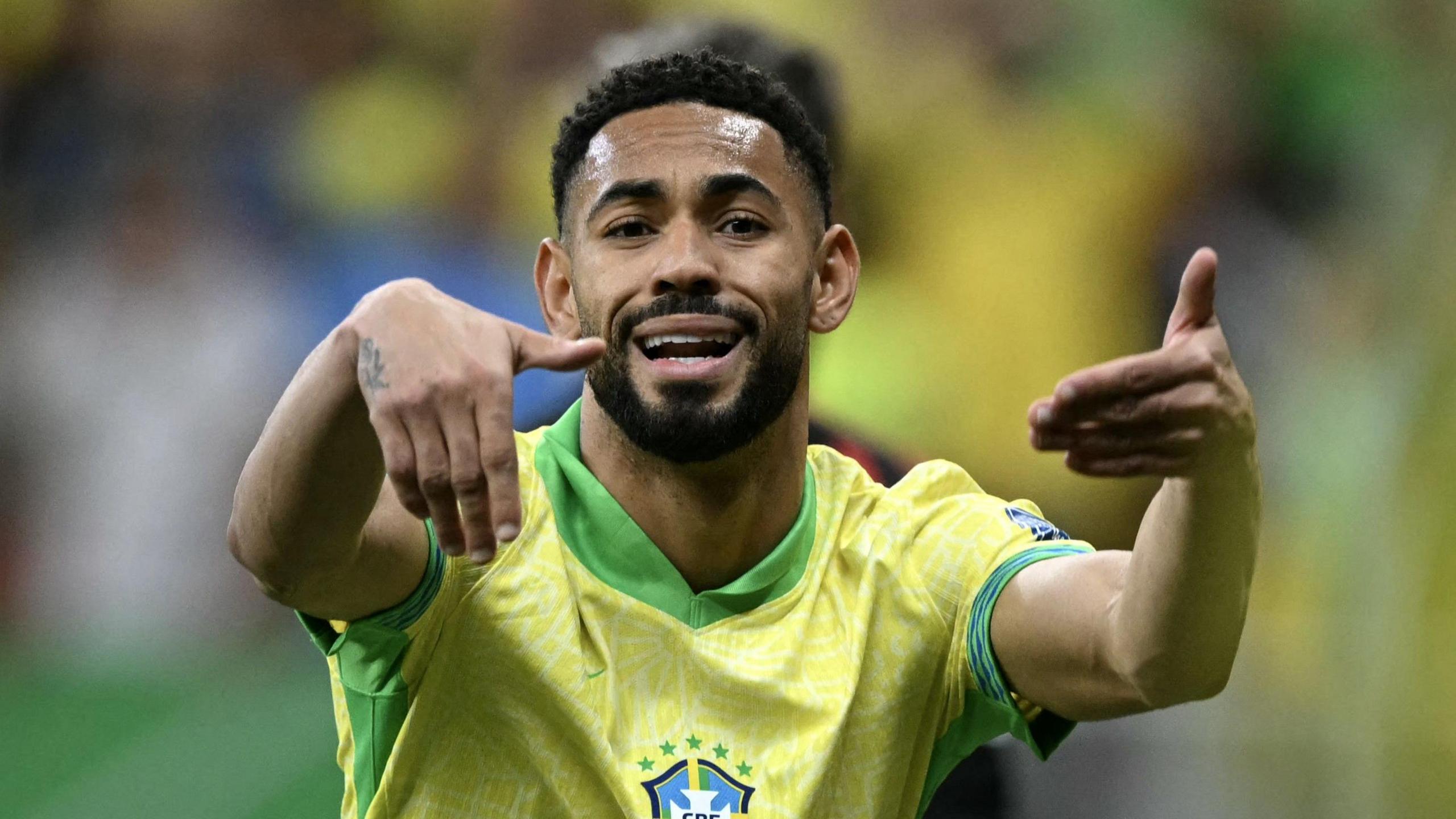
Matheus Cunha: Brazil forward says he wants to take Wolves to 'another level' - BBC Sport
| Brazil 4-2-3-1 | Japan 3-4-2-1 |
|---|---|
| Alisson (GK) | Zion Suzuki (GK) |
| Danilo (RB) | Takehiro Tomiyasu (RCB) |
| Marquinhos (CB, C) | Ko Itakura (CB, C) |
| Gabriel Magalhaes (CB) | Hiroki Ito (LCB) |
| Douglas Santos (LB) | Ritsu Doan (RWB) |
| Casemiro (CDM) | Kaishu Sano (CM) |
| Bruno Guimaraes (CDM) | Daichi Kamada (CM) |
| Raphinha (RW) | Keito Nakamura (LWB) |
| Lucas Paqueta (CAM) | Junya Ito (RF) |
| Vinicius Junior (LW) | Takefusa Kubo (LF) |
| Matheus Cunha (ST) | Ayase Ueda (ST) |
Head-to-Head Record

Go to Google Home
Brazil and Japan have met on six previous occasions at senior international level, with Brazil dominating the historical record with five victories to Japan's one. The most significant meeting came at the 2006 FIFA World Cup in Germany, where Brazil cruised to a 4-1 victory in Group F, with Ronaldo scoring twice and Juninho and Gilberto also finding the net. Japan's solitary goal that day came from Keiji Tamada, but the match highlighted the gulf in class between the two nations at that time. However, the landscape has shifted dramatically in the two decades since, with Japan's footballing infrastructure and player development producing a generation of technically gifted footballers capable of competing with the world's elite. The most recent encounter, a friendly in Tokyo on October 14, 2025, saw Japan secure their first-ever victory over Brazil with a stunning 3-2 comeback, with goals from Takumi Minamino, Keito Nakamura, and Ueda Ayase overturning a 2-0 deficit. This result shattered the psychological barrier and proved that Japan can no longer be considered mere underdogs against the Selecao. For detailed analytical sports predictions based on historical data, this head-to-head trend reversal is significant.
Across these six encounters, Brazil have scored 18 goals to Japan's 5, averaging three goals per game against the Samurai Blue. However, the October 2025 friendly marked a turning point, with Japan not only scoring three goals for the first time against Brazil but also demonstrating that their pressing game could disrupt Brazil's rhythm and force errors in dangerous areas. The psychological impact of that victory cannot be understated; Japan will enter NRG Stadium knowing they have the tactical blueprint and personnel to trouble Brazil, while the Selecao will be acutely aware that their historical dominance guarantees nothing in the pressure-cooker environment of a World Cup knockout match. Bettors seeking double chance predictions should note that Japan's improved record makes a draw within 90 minutes a realistic possibility. The aggregate scoreline of 18-5 flatters Brazil's historical superiority, but recent trends suggest a much tighter contest is on the cards.
Key Players Comparison
Vinicius Junior (Brazil)
The Real Madrid superstar has been Brazil's most dangerous weapon in the tournament, using his explosive pace, dribbling ability, and improved finishing to terrorize defenses. With two goals in the group stage and a constant threat from the left, he will be Japan's primary defensive concern. His ability to draw multiple defenders creates space for Cunha and Paqueta to exploit.
Takefusa Kubo (Japan)
Japan's creative talisman operates in the half-spaces between midfield and defense, where his close control and vision can unlock even the most organized backlines. The Real Sociedad playmaker has 48 caps and 7 goals for Japan, and his ability to find pockets of space will be crucial against Brazil's compact defensive structure.
Matheus Cunha (Brazil)
The Wolves striker has thrived in Ancelotti's system, dropping deep to link play and making intelligent runs in behind. His two goals against Haiti and Scotland showcased his clinical finishing, and his physical presence will test Japan's technically gifted but physically smaller defenders.
Ayase Ueda (Japan)
The Feyenoord striker has been Japan's most reliable goalscorer in the tournament, with a brace against Tunisia and 16 goals in 38 international appearances. His movement off the shoulder of the last defender and his ability to finish under pressure make him Japan's best hope for a breakthrough against Brazil's defense.
Casemiro (Brazil)
The veteran Manchester United midfielder provides the defensive shield that allows Brazil's creative players to flourish. His tactical intelligence, developed under Ancelotti at Real Madrid, means he understands exactly what the manager demands in transition moments. His battle with Kamada and Sano will determine who controls the midfield.
Daichi Kamada (Japan)
The Crystal Palace midfielder has been one of Japan's standout performers, scoring crucial goals against Tunisia and the Netherlands. His ability to arrive late in the box and his set-piece delivery make him a multi-faceted threat that Brazil cannot afford to ignore.
The individual battles across the pitch will be fascinating. Vinicius Junior against Takehiro Tomiyasu is a matchup of pure pace and dribbling against tactical intelligence and physical resilience. In midfield, Casemiro's destructive capabilities will be tested by the movement and technical quality of Kamada and Sano. At the back, Marquinhos and Gabriel must use their physical advantage to dominate Ueda and prevent Japan from building attacks through the center. The rise of modern strikers like Cunha and Ueda shows how the number nine role has evolved, with both players comfortable dropping deep or stretching defenses in behind. These micro-battles will collectively determine the macro outcome of this heavyweight clash.
The Managers
Carlo Ancelotti (Brazil)
The most decorated manager in European football history, Ancelotti took charge of Brazil with a clear mandate: bring the World Cup back to South America for the first time since 2002. His man-management skills and ability to create harmonious dressing rooms have been evident, with even the notoriously difficult Neymar situation handled with diplomatic finesse. Ancelotti's tactical flexibility—shifting between 4-3-3 and 4-2-3-1 depending on the opponent—has given Brazil a structure they lacked in previous tournaments. His decision to leave Joao Pedro, Richarlison, and Gabriel Jesus at home was controversial but demonstrated his ruthless selection criteria based on form rather than reputation.
Ancelotti's experience in knockout football is unparalleled, with four Champions League titles to his name. He understands that tournament football requires different approaches for different stages, and his calm demeanor on the touchline provides a stabilizing influence when matches become tense. Against Japan, he will likely emphasize controlling possession and forcing Japan to defend deep, knowing that the Samurai Blue are most dangerous when allowed to counter-attack at pace. His strategic approach to high-stakes matches has made him a legend in the sport, and Brazil will look to leverage that expertise.
Hajime Moriyasu (Japan)
The architect of Japan's modern footballing renaissance, Moriyasu became the first manager to lead Japan in back-to-back World Cup cycles after the JFA broke tradition to extend his contract following the Qatar 2022 heroics. His "chameleon" philosophy—adapting tactics to exploit specific opponent weaknesses rather than adhering to a rigid ideology—has made Japan one of the most tactically sophisticated teams in the tournament. The viral whiteboard incident during the Netherlands match, where Moriyasu used numbered signs to communicate time management to his players, showcased his innovative approach to in-game coaching.
Moriyasu's personal connection to national team trauma—the "Agony of Doha" in 1993, where he was on the pitch when Japan missed World Cup qualification in the final minute—has instilled a culture of resilience and mental fortitude. His "super-sub" strategy, holding back explosive attackers until the second half to exploit tired legs, has been a hallmark of his tournament management. Against Brazil, Moriyasu will likely instruct his team to defend compactly and look to transition quickly through Kubo and Doan when Brazil's full-backs are caught high. His ability to make decisive tactical adjustments mid-match could be Japan's greatest asset if the game remains tight. For those analyzing live betting opportunities, Moriyasu's second-half substitutions often create dramatic shifts in momentum.
Betting Predictions & Tips
Odds: 1.65
Brazil's superior individual quality, physical advantage, and knockout tournament experience make them the justified favorites. While Japan's tactical discipline and recent friendly victory provide genuine hope, the World Cup knockout stage is a different beast entirely. Brazil's improved defensive organization since the Morocco draw, combined with their ability to control possession and force opponents into uncomfortable defensive positions, should see them through. The 1.65 odds offer reasonable value given Brazil's historical dominance and the pressure on them to perform. Ancelotti's tournament management expertise and the presence of match-winners like Vinicius Junior and Casemiro provide the marginal gains that decide tight knockout matches. For more today's football predictions, this is our strongest recommendation.
Odds: 1.85
Knockout football at the World Cup is typically more cautious than group stage matches, with teams prioritizing defensive solidity over attacking ambition. Brazil's 4-4-2 mid-block out of possession is designed to limit space in dangerous areas, while Japan's 3-4-2-1 relies on compactness and quick transitions rather than sustained attacking pressure. Both teams have shown defensive resilience in the tournament—Brazil kept clean sheets against Haiti and Scotland, while Japan conceded only three goals in three group matches against quality opposition. The tactical battle between Ancelotti's controlled possession and Moriyasu's counter-attacking discipline suggests a low-scoring affair. The 1.85 odds represent excellent value for a match that is likely to be decided by a single moment of brilliance or a defensive error. Our over/under prediction models strongly favor the under in this fixture.
Odds: 6.50
Our prediction model suggests a narrow Brazil victory by a single goal, reflecting the tactical conservatism expected in a knockout match of this magnitude. Brazil's ability to control possession and create chances through patient build-up, combined with Japan's resilience and counter-attacking threat, points to a game where one goal could be enough. The 1-0 scoreline has been a common result in World Cup Round of 32 matches between teams of relatively equal standing, and the 6.50 odds offer attractive returns for bettors willing to back a tight contest. Brazil's aerial advantage from set-pieces and Japan's occasional vulnerability when dealing with high balls into the box could be the decisive factor. Check our correct score tips for more detailed analysis on this market.
Odds: 1.90
While Japan's attacking quality has improved dramatically, Brazil's defensive record under Ancelotti has been impressive when they prioritize organization over expression. In knockout matches, the Selecao are likely to adopt a more conservative approach, focusing on nullifying Japan's counter-attacking threats before committing numbers forward. Japan may struggle to create clear-cut chances against Brazil's compact defensive structure, particularly if Moriyasu opts for caution against superior individual talent. The 1.90 odds for BTTS No reflect the likelihood of a strategically controlled match where defensive discipline takes precedence over attacking ambition. This aligns with our betting strategy guides that emphasize tactical context over raw attacking statistics.
Odds: 2.40
For those seeking higher returns, Vinicius Junior to score anytime at 2.40 offers speculative value. The Real Madrid winger has been Brazil's most consistent attacking threat, scoring twice in the group stage and constantly troubling defenders with his direct running and improved finishing. Against Japan's back three, his ability to isolate wing-backs and cut inside onto his stronger right foot could create multiple shooting opportunities. While Japan's defensive organization is excellent, individual brilliance often decides tight knockout matches, and Vinicius possesses that game-changing quality in abundance. The 2.40 odds are generous for a player of his caliber in a match where Brazil are expected to dominate possession and create chances. Explore more value betting opportunities across today's fixtures.
📊 Final Score Prediction
Match Analysis
Brazil will secure a hard-fought 1-0 victory over Japan in a tactical chess match that showcases the best of both footballing cultures. The Selecao's superior physicality, individual quality, and tournament experience will ultimately prove decisive, but Japan's disciplined defensive organization and counter-attacking threat will ensure the contest remains tense until the final whistle. Expect Brazil to control possession in the first half, probing Japan's compact back three without creating clear-cut chances, before introducing the pace of Vinicius Junior and the physicality of Endrick from the bench to stretch the game in the second period. The decisive goal is likely to come from a set-piece or a moment of individual brilliance, with Marquinhos or Gabriel Magalhaes capitalizing on Japan's aerial vulnerability, or Vinicius Junior producing a piece of magic that Japan's collective defense cannot prevent. For full-time predictions and detailed match analysis, our model consistently points to a narrow Brazil win.
Japan will not make this easy. Moriyasu's tactical acumen and his players' technical quality mean they will create moments of danger, particularly on the counter-attack through Kubo and Ueda. However, Brazil's defensive organization under Ancelotti—evident in the clean sheets against Haiti and Scotland—should be sufficient to limit Japan to half-chances and long-range efforts. The psychological pressure of a World Cup knockout match, combined with Brazil's historical dominance and the presence of multiple match-winners, gives the South Americans the edge in a contest that could be decided by the finest of margins. The 1-0 scoreline reflects both teams' defensive capabilities and the cautious nature of knockout football, where a single goal is often enough to separate two well-matched sides. Those looking for betting odds education will find this match an excellent case study in how tactical context influences market pricing.
Key Insights & Statistics

Ayase Ueda: 2 goals, 1 assist, Sofascore Rating 9.6
- Brazil have won five of their six previous meetings with Japan, scoring 18 goals and conceding just five, though Japan's 3-2 victory in the October 2025 friendly ended that historical dominance.
- Brazil's starting XI averages 30.5 years with a combined market value of approximately €497.3 million, while Japan's XI averages 27.8 years with a combined value of roughly €162 million.
- Japan have reached the Round of 16 in four of their last five World Cup appearances but have never progressed beyond this stage, creating a "glass ceiling" that Moriyasu is desperate to break.
- Brazil kept clean sheets in their last two group matches against Haiti and Scotland, conceding only one goal in the entire group stage—the equalizer against Morocco.
- Japan's 4-0 victory against Tunisia was their biggest World Cup win ever, surpassing their previous record and demonstrating their attacking evolution under Moriyasu.
- Vinicius Junior has scored two goals in the tournament and created 12 chances, making him Brazil's most dangerous attacking weapon and the player Japan must neutralize.
- Ayase Ueda has scored 16 goals in 38 caps for Japan and netted a brace against Tunisia, making him the Samurai Blue's most reliable finisher in the penalty area.
- Brazil's midfield trio of Casemiro, Bruno Guimaraes, and Lucas Paqueta have a combined 187 international caps, providing experience and tactical intelligence that Japan's younger midfield cannot match.
- Japan's 3-4-2-1 formation has allowed them to average 52% possession in the group stage while maintaining a pass completion rate of 84.1%, demonstrating their technical competence against European opposition.
- The match at NRG Stadium in Houston will kick off at 15:00 local time, with temperatures expected to be in the mid-30s Celsius, potentially favoring Brazil's South American conditioning over Japan's adaptability.
- Carlo Ancelotti has won four Champions League titles and managed in 18 major finals; this is his first World Cup, but his knockout experience is unmatched in international football.
- Hajime Moriyasu's "whiteboard" innovation during the Netherlands match went viral and showcased his ability to communicate complex tactical adjustments quickly in high-pressure moments.
- Brazil have not won the World Cup since 2002, creating a 24-year drought that has become a national obsession and adds immense pressure to every knockout match.
- Japan's squad features players from 23 different clubs across Europe, Asia, and the Americas, making them one of the most cosmopolitan squads in the tournament.
- The winner of this match will face either the Netherlands or Sweden in the Round of 16, with a potential quarter-final against Argentina or Germany looming for the victor.
Conclusion
The Brazil vs Japan Round of 32 clash at the 2026 FIFA World Cup represents a fascinating intersection of footballing history and modern tactical evolution. Brazil, the five-time champions burdened by a 24-year drought and the weight of national expectation, face a Japan side that has shattered the "glass ceiling" narrative and proven they can compete with the world's elite. The tactical battle between Ancelotti's possession-based 4-2-3-1 and Moriyasu's adaptable 3-4-2-1 will be a masterclass in contrasting philosophies, with Brazil's individual brilliance and physical superiority pitted against Japan's collective discipline and technical sophistication. Our prediction of a 1-0 Brazil victory reflects both the Selecao's marginal advantages in key areas and the cautious nature of knockout football, where defensive organization often trumps attacking ambition. For comprehensive tomorrow's football predictions and ongoing tournament coverage, stay updated with our analysis.
However, this match is far from a foregone conclusion. Japan's historic 3-2 victory over Brazil in October 2025 proved that the Samurai Blue possess the tactical blueprint and mental fortitude to trouble even the most storied opponents. If Moriyasu can successfully neutralize Vinicius Junior and force Brazil into wide areas where Japan's back three can defend crosses, and if Ueda and Kubo can exploit the space behind Brazil's attacking full-backs on the counter, an upset is genuinely possible. The knockout stage of the World Cup is where legends are made and reputations are forged, and both teams have everything to play for. Brazil seek to end their quarter-century wait for glory, while Japan aim to finally break into the last eight and cement their status as a genuine footballing powerhouse. For bettors, the understanding of betting odds and tactical context is crucial in navigating what promises to be one of the most compelling matches of the 2026 tournament. Regardless of the outcome, this fixture will showcase the beautiful game at its most strategic and intense, a fitting spectacle for the world's biggest stage.
Ultimately, Brazil's experience, depth, and the sheer quality of players like Vinicius Junior, Casemiro, and Marquinhos should see them through a tight contest. The Selecao's ability to control the tempo of the match, combined with their aerial dominance from set-pieces and the tactical wisdom of Ancelotti, provides the marginal gains that decide knockout football. Japan will push them to the limit, and the Samurai Blue can leave Houston with their heads held high regardless of the result, knowing they have once again proven their credentials on the world stage. But for Brazil, nothing less than victory is acceptable, and that desperation, channelled through world-class talent, should be enough to secure a place in the Round of 16 and keep their World Cup dream alive. The football world will be watching as samba meets samurai in what promises to be an unforgettable encounter at NRG Stadium. For more expert analysis and betting insights, visit our comprehensive sports coverage hub.